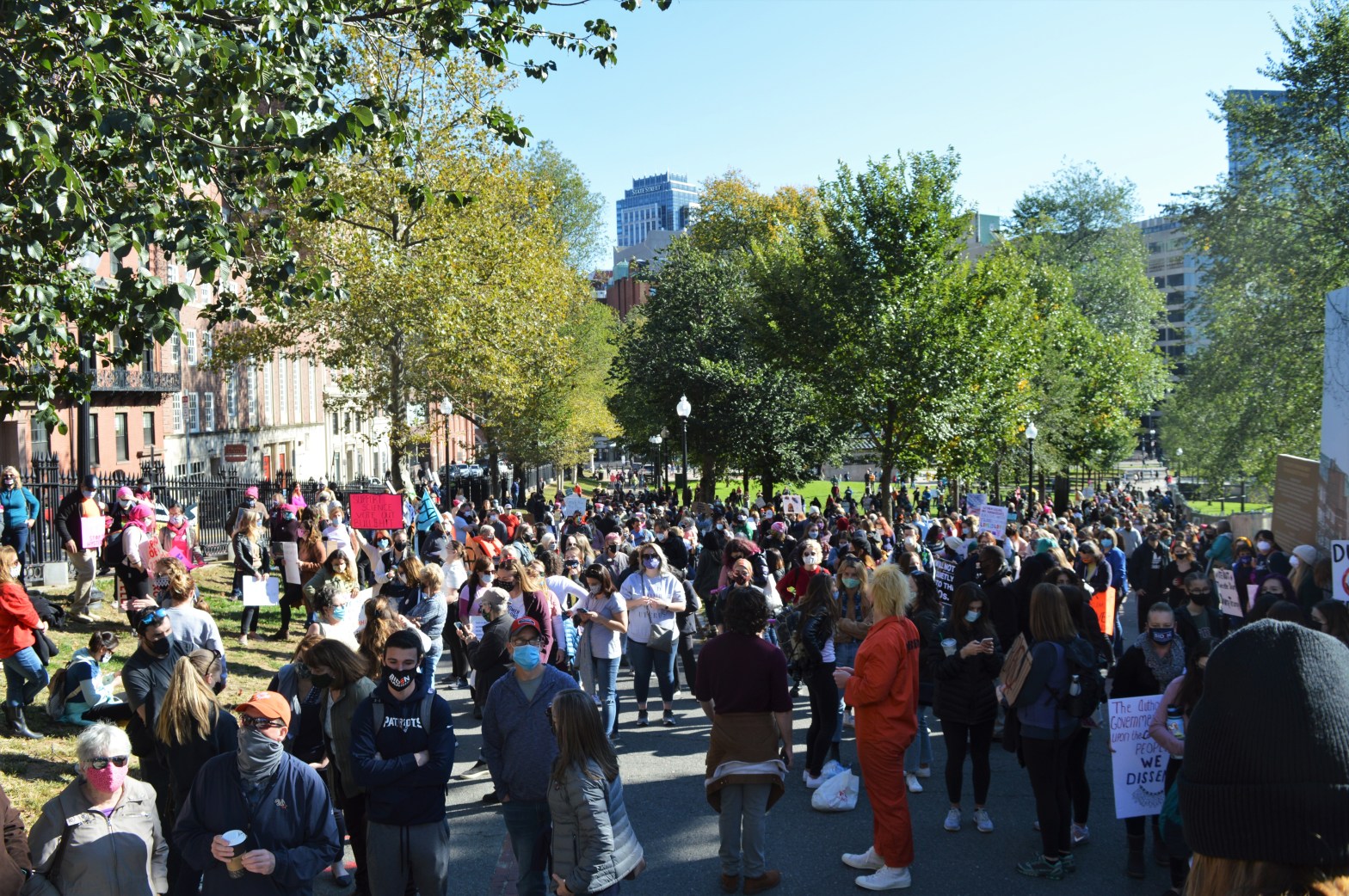
Angry, impassioned and hopeful, thousands of people gathered across the country on Saturday, Oct. 17 for the annual Women’s March.
In Boston, Siobhan Reidy, a political science student at the University of Massachusetts Amherst, organized hundreds of people to meet on the steps of Boston Common in support of women’s rights. “This is our fight. This is our country. This is our chance,” she said, prompting a wave of cheers from attendees.

This year’s march focused highly on voter turnout and how the 2020 election will impact the lives of all Americans for years to come.
Michelle Wu, a Boston City Councilor and candidate for Mayor, told demonstrators that Black lives, reproductive rights, LGBT rights, and public health were some of the most important issues that people will be voting for on Nov. 3. “It’s exhausting thinking about how much is on the ballot,” she said.
This sentiment was echoed by Reidy in an interview. “Reproductive rights are on the line. Marriage equality is on the line. The lives of Black, Indigenous, and people of color, their lives are on the line, their rights are on the line,” she said. “The environment is on the line … another four years of Trump means that there’s another four years that will go by where we’re just harming the planet.”
Another major concern of attendees was the nomination of Amy Coney Barrett to the Supreme Court, in which she would assume the seat of the late Justice Ruth Bader Ginsburg.
Justice Ginsburg, lovingly known as RBG, expressed her dying wish to her granddaughter, Clara Spera, in the days before her death. “My most fervent wish is that I will not be replaced until a new president is installed,” she said, as reported by NPR.
Critics of President Donald Trump’s decision to move forward feel as if he is disrespecting RBG’s dying wish. Jess, a 26-year-old Boston healthcare worker attending the march, said that there was a lot of hypocrisy surrounding the nomination of Barrett. “The Supreme Court is being essentially stolen,” she said. Women’s March organizers said that they demanded that “the memory and legacy of Justice Ginsburg’s lifelong fight for equal rights is properly honored by fulfilling her final wish that the nomination of her replacement is delayed until after election day.”

Many are also worried about the implications of Barrett being elected to the Supreme Court. “The fear is that, regardless of what she said during the nomination hearings, her history shows that Roe v. Wade will be a target,” Reidy said. “A heavily conservative bench means that … Roe v. Wade will go, Obergefell v. Hodges will go, the [Affordable Care Act] will go. Everything that we all love, everything that’s keeping Americans safe and equal will disappear.”
Multiple speakers inspired the crowd with their stories of political activism and calls for action. “Four years ago, I was an angry citizen of this state, and I used that anger to form the Women’s Party,” said state Rep. Lindsay Sabadosa.
Days after the 2016 election, Sabadosa, who did not hold public office at the time, organized approximately seven busloads of people to travel to Washington, D.C., to join the march and protest Trump’s election. She then ran for state office in 2019, winning the race to represent the 1st Hampshire district in the Massachusetts State House.
“[Trump] promised he was going to attack Roe v. Wade. Mission accomplished. He promised to attack healthcare. Well, here we are, in the middle of a global pandemic with the ACA under attack again,” said Sabadosa. “I thought his presidency was going to be bad. But I did not realize the extent to which he would use that office to wage war on the American people.”
22-year-old Toiell Washington, co-founder of Black Boston, urged people to support all Black women, regardless of occupation, criminal history, attractiveness, or countenance. She then led the crowd through a call and response, having them loudly repeat “I will protect Black women. I will support women. I will believe Black women.”

“Feminism without intersectionality is white supremacism,” she said. “When we march today, keep intersectionality in the back of your mind.”
Hundreds of demonstrators looped around Boston Common alongside people cheering in their cars before continuing on to Boston City Hall.
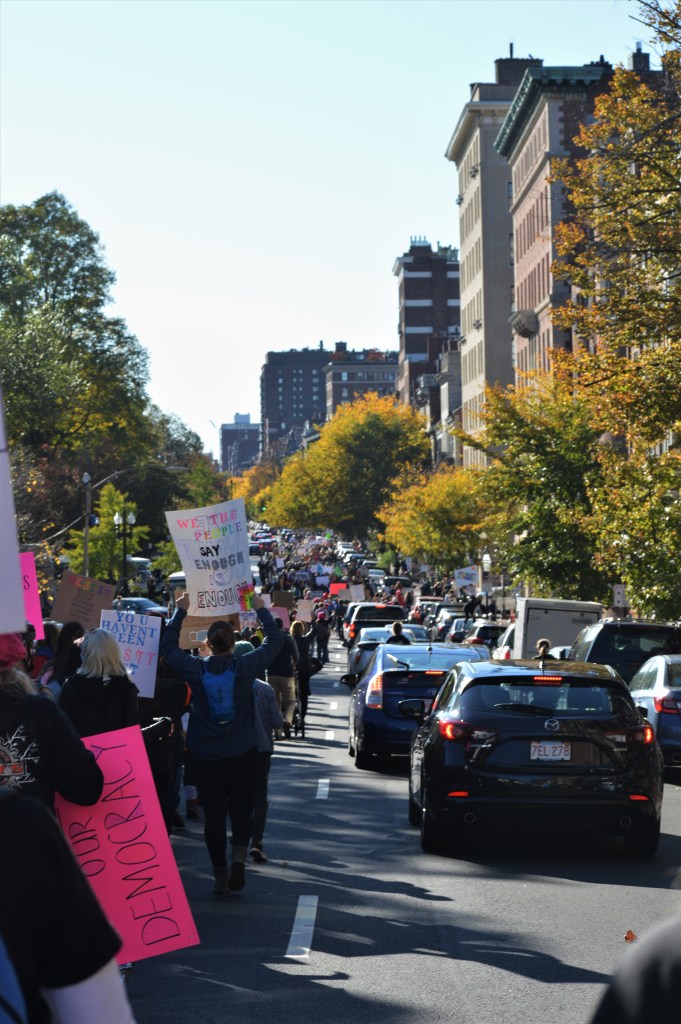
The march continues on Beacon Street around Boston Common Demonstrators gather outside Faneuil Hall

“It felt like people who couldn’t make it here or didn’t think to go, or maybe didn’t really feel it was important to go, were still voicing their opinion and standing with us, which was just really empowering and supportive,” said Reidy. She said that “having that moment where everyone is so supportive and coming together” to chant and dance outside of Faneuil Hall was one of the most impactful moments of the march for her, but reemphasized the need to vote.
“This is the election of our lifetime, for our lives. The importance of voting cannot be overstated,” she said. “Even in a state that, like Massachusetts, feels like it’s safe because it feels like no matter what it’s going to go blue, that’s not a guarantee. And I think we just need to always, forever, emphasize the absolute need to vote.”
Update: Amy Coney Barret was confirmed as a Supreme Court Justice in a 52-48 Senate vote on Oct. 26.
 Quillan Anderson
Impressive writing by you!
LikeLike